
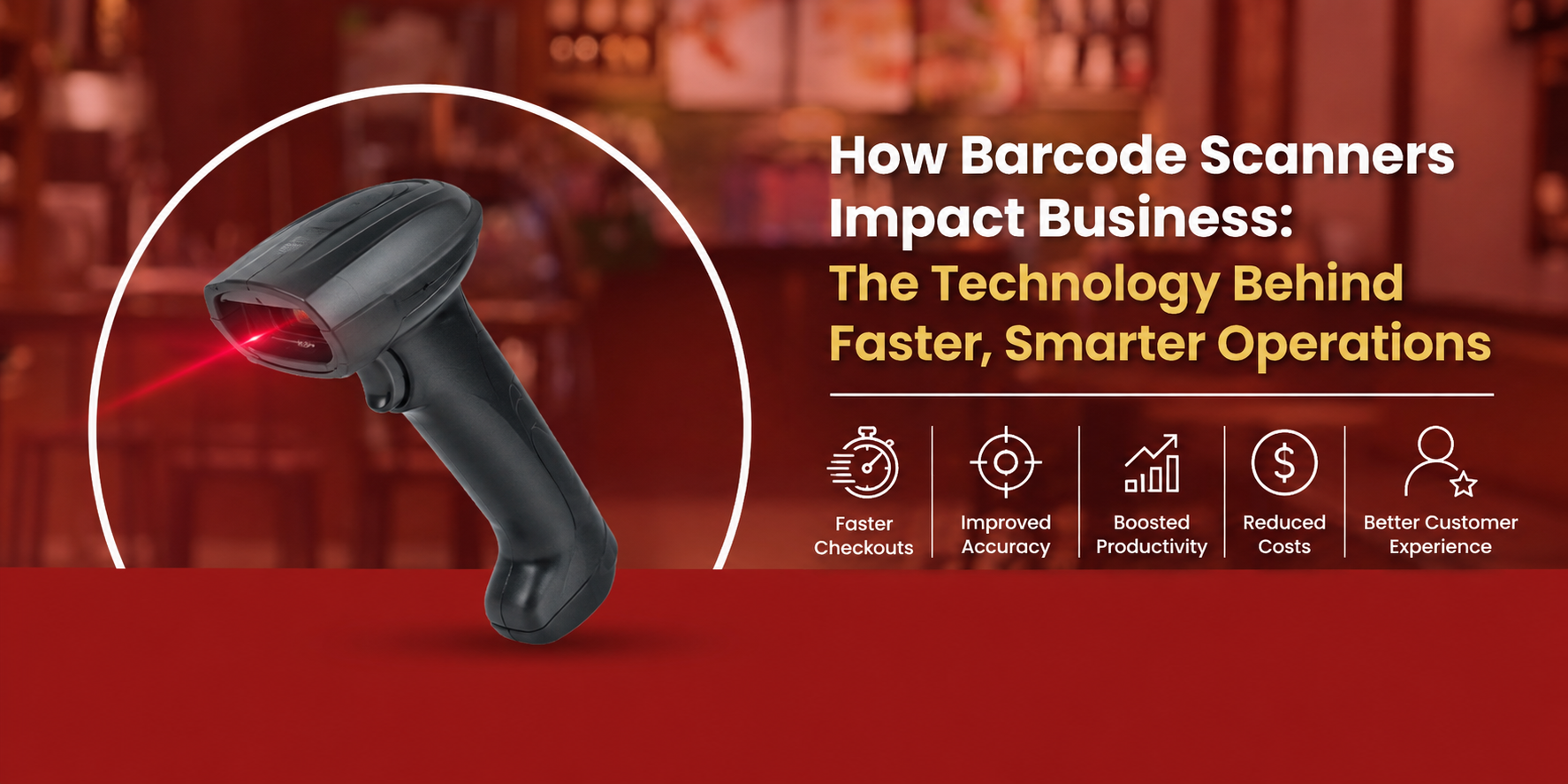
A barcode scanner is easy to overlook.
It sits beside a billing counter, warehouse workstation, or POS terminal, waiting for the next product to pass in front of it. There is usually a quick beep, and the process moves on.
But that beep represents much more than a product being identified.
It can trigger a transaction, update inventory, capture sales data, reduce manual work, and keep business operations moving.
That is why the role of barcode scanners has evolved far beyond simply scanning products. Today, they are an important part of how businesses capture information, reduce friction, and improve operational efficiency.
From a Barcode to a Business Decision
A barcode is essentially a product’s identity in a machine-readable format.
The scanner captures that identity and sends it to a connected system, such as a POS, inventory platform, warehouse management system, or other business software.
The process looks simple:
Scan → Identify → Process → Record → Act
But this simple workflow can influence several areas of a business.
A product scan at checkout can update a sale.
A scan during stock receiving can record incoming inventory.
A scan in a warehouse can help track product movement.
A scan during stock counting can reduce manual data entry.
The scanner is therefore not just an input device. It can become an important link between physical products and digital business information.
Business Operations: With vs. Without Barcode Scanning
The difference isn’t simply about whether a business can scan a product. It is about how efficiently information moves through the business.
| Business Activity | Without Barcode Scanning | With Barcode Scanning |
|---|---|---|
| Product Identification | Employees manually search or enter product information | Product information can be captured instantly |
| Checkout | More manual entry and potentially slower transactions | Faster product identification and billing |
| Inventory Updates | Greater dependence on manual updates | Products can be scanned during stock movement |
| Data Entry | More typing and repetitive work | Less manual data entry |
| Accuracy | Higher possibility of typing or selection errors | More consistent product identification |
| Stock Counting | Can require significant manual effort | Scanning can speed up counting and recording |
| Employee Productivity | More time spent on repetitive tasks | More time available for customer service and other activities |
| Customer Experience | Potentially longer checkout processes | Smoother and faster transactions |
| Product Tracking | More difficult to maintain consistently | Easier to record product movements |
| Business Data | More manual information collection | More structured transaction and inventory data |
The Difference in One Line
Without barcode scanning:
Manual entry → More effort → More opportunities for errors → Slower processes
With barcode scanning:
Scan → Capture information → Process → Update → Move to the next task
Why This Difference Matters
For one product, the difference may seem insignificant.
But imagine processing 500, 1,000, or 10,000 products.
A few seconds saved per transaction can become hours of saved time. Fewer manual entries can mean fewer opportunities for mistakes, while consistent data capture can provide better visibility into business operations.
So the real comparison isn’t:
“Scanner vs. No Scanner.”
It is:
“Manual processes vs. streamlined processes.”
That makes barcode scanning more than a hardware upgrade—it becomes an operational efficiency tool.
The Business Impact of Barcode Scanning
1. The Real Cost of Slow Processes
Businesses often focus on major expenses such as equipment, staffing, logistics, or infrastructure.
But there is another cost that is easy to miss:
Time lost through repetitive processes.
Consider a simple product transaction.
Without scanning technology, an employee may need to search for an item, enter a code, verify the product, and confirm the price.
With barcode scanning, much of that process can happen almost instantly.
Now multiply those few saved seconds by:
- Hundreds of transactions per day
- Thousands of products
- Multiple employees
- Multiple business locations
What looks like a small improvement at the individual transaction level can become a significant operational gain.
2. Accuracy Starts at the Point of Capture
Business systems are only as reliable as the information entering them.
Manual data entry creates opportunities for mistakes.
A single incorrect digit can result in the wrong product being selected or incorrect information being recorded.
Barcode scanners reduce the amount of information employees need to type manually.
Instead of relying on memory or repeated data entry, the scanner captures the encoded product information directly.
This can help businesses improve:
Data accuracy → Transaction accuracy → Inventory accuracy
And better accuracy can mean fewer corrections, fewer discrepancies, and smoother operations.
- Inventory: Where Every Scan Counts
Inventory management is one of the areas where barcode scanning can have a major operational impact.
Think about everything that happens to a product before it reaches the customer.
Received → Stored → Moved → Counted → Sold
Every movement creates an opportunity to update information.
Barcode scanning can help businesses record these movements more consistently.
Instead of relying entirely on manual updates, employees can scan products as they move through different stages of the operation.
This creates better visibility into what is coming in, what is moving out, and what remains available.
Why does this matter?
Because businesses cannot make good inventory decisions if they don’t have reliable inventory information.
Better visibility can help businesses identify:
- Fast-moving products
- Slow-moving stock
- Stock shortages
- Inventory discrepancies
- Reordering requirements
The scanner isn’t making these decisions.
It is helping provide the information needed to make them.
- The Checkout Experience Is a Business Experience
Customers may never ask what barcode scanner a store uses.
But they notice when checkout is slow.
They notice when an employee has to manually search for a product.
They notice when prices need to be checked repeatedly.
They notice long queues.
A faster scanning process can help remove these points of friction.
For businesses, this means barcode scanning isn’t only an operational technology.
It can also contribute to customer experience.
A smoother checkout can help create a transaction that feels quick, simple, and effortless.
And in retail, those small experiences matter.
- Barcode Scanners Give Employees More Time to Work
Technology shouldn’t only be measured by how quickly a machine performs a task.
It should also be measured by how much unnecessary work it removes from employees.
Imagine an employee spending part of every working day:
- Typing product codes
- Searching product records
- Correcting incorrect entries
- Manually checking stock information
Barcode scanning can automate much of this repetitive work.
That gives employees more time to focus on tasks that require human attention, such as helping customers, organizing products, managing exceptions, or improving operations.
Automation isn’t about replacing the employee.
It is about reducing the repetitive workload around the employee.
- Barcode Scanning Creates a Connected Business Workflow
One of the biggest advantages of modern scanning technology is integration.
A scanner can connect with systems that businesses already use.
For example:
Barcode Scanner
POS System
Sales Information
Inventory Update
Reports & Insights
This creates a flow of information instead of isolated activities.
The product is scanned once, but the information can potentially support several business functions.
That is where barcode scanning becomes much more valuable than simple data capture.
- The Impact Extends Beyond Retail
Barcode scanners are commonly associated with supermarkets and retail stores, but their applications extend much further.
Warehousing
Scanners can support receiving, picking, packing, stock counting, and product movement.
Logistics
Barcode scanning can help identify packages and track shipments as they move through different stages.
Manufacturing
Products, components, and materials can be identified and tracked during production workflows.
Healthcare
Barcode technology can support the identification and tracking of products, equipment, and other items.
Hospitality
Scanning can support inventory and operational processes where product identification is required.
The environment changes, but the underlying principle remains the same:
Identify faster. Record accurately. Move efficiently.
- Not Every Business Needs the Same Scanner
Choosing a barcode scanner shouldn’t begin with the question:
“Which model is popular?”
It should begin with:
“What problem are we trying to solve?”
A high-volume retail counter may need fast presentation scanning.
A warehouse employee may need a handheld scanner that can move with them.
A self-service environment may require a scanner designed for kiosk integration.
A business handling mobile coupons or digital tickets may need reliable 1D and 2D scanning capabilities.
Important factors can include:
- 1D and 2D barcode support
- Scanning speed
- Scanning range
- Screen scanning capability
- Wired or wireless connectivity
- Durability
- Mounting requirements
- POS compatibility
- Operating environment
The best scanner is therefore not necessarily the one with the longest feature list.
It is the one that fits the workflow.
The Business Impact at a Glance
| Area | How Barcode Scanning Can Help |
| Checkout | Faster product identification |
| Data Entry | Reduced manual typing |
| Accuracy | Fewer entry-related mistakes |
| Inventory | Better product tracking |
| Employees | Less repetitive work |
| Customer Experience | Smoother transactions |
| Operations | More connected workflows |
| Reporting | More reliable transaction data |
Now, Where to Buy Barcode Scanners in India?
After understanding how barcode scanners can improve billing, inventory, accuracy, and operational efficiency, the next question is simple:
“Where can you find the right barcode scanner for your business in India?”
Rugtek has a range of barcode scanning solutions designed for different business environments, including retail, POS, inventory, and warehouse applications.
Whether you need a wired, wireless, handheld, or 1D/2D scanning solution, you can explore Rugtek’s range and choose a scanner based on your specific workflow and requirements.
Looking for the right barcode scanner for your business? Explore Rugtek and find the solution that fits your workflow.
Frequently Asked Questions About Barcode Scanners
A barcode scanner is a device that reads information encoded in 1D or 2D barcodes and sends that data to a connected system such as a POS, inventory, or warehouse management system.
Barcode scanners reduce manual data entry, speed up product identification, minimise repetitive tasks, and help businesses process transactions and inventory movements more efficiently.
Yes. By capturing product information directly from the barcode, scanners can reduce errors associated with manually entering product codes and other information.
They can help businesses record products as they are received, moved, counted, or sold. This provides better visibility into stock levels and product movement.
Many modern scanners support both traditional 1D barcodes and 2D codes such as QR codes. However, capabilities vary by scanner model, so businesses should check the specifications before choosing a device
Many modern scanners support both traditional 1D barcodes and 2D codes such as QR codes. However, capabilities vary by scanner model, so businesses should check the specifications before choosing a device
Barcode scanners are widely used in retail, supermarkets, warehouses, logistics, manufacturing, healthcare, hospitality, and other industries that need fast and accurate product or item identification.
Consider your environment, scanning volume, barcode types, scanning distance, connectivity, durability, POS compatibility, and whether you need handheld, countertop, presentation, or fixed-mount scanning.
Yes. Small businesses can use barcode scanners to simplify billing, improve inventory tracking, reduce manual work, and create more efficient day-to-day operations.
A 1D scanner reads traditional linear barcodes, while a 2D scanner can read two-dimensional codes such as QR codes and Data Matrix codes. Many 2D scanners can also read 1D barcodes.